
A Lasting Fix for a Bulge Near an Old Surgical Scar
A bulge, ache or pressure near a previous abdominal incision is often an incisional hernia. These hernias do not heal on their own and tend to grow over time. At Matthew Lublin, MD, Dr. Lublin repairs incisional hernias with tension-free mesh techniques. He often uses small-incision laparoscopic or robotic methods. Patients are seen at our offices in Santa Monica and Encino, CA, and many can return to normal life sooner and with less pain. Call to talk about your options.
Request an AppointmentWhat Is an Incisional Hernia?
An incisional hernia forms at or near the site of a previous surgical incision in the abdominal wall. When a surgeon cuts through the abdominal wall, the healed area is never quite as strong as the surrounding tissue. Over time, the fascia, the tough layer that holds the abdominal wall together, can thin out and separate. This leaves a hole that abdominal contents can push through.
The tissue that pushes through is usually the small intestine or the omentum, a layer of fatty tissue that lines the abdominal cavity. This creates a lump or bulge you can see or feel near your scar. Almost any prior abdominal operation can lead to an incisional hernia, including open procedures and, less often, laparoscopic ones.
When and Why Incisional Hernias Develop
An incisional hernia can show up soon after surgery, or it may not appear for months or even years. Size varies widely. Some are small, and others are large and complex. The two main causes are:
- Poor wound healing, which can be linked to infection, excess weight, poor nutrition, smoking or certain medications, most commonly steroids
- Repeated strain on the incision, such as heavy lifting, chronic coughing or straining
Symptoms to Watch For
The most common sign is a bulge at or near your previous surgical scar. It may be more noticeable when you stand, cough or strain, and it may flatten when you lie down. Many people feel discomfort or pain around the area, especially when abdominal contents get caught in the opening. You can learn more about common warning signs on our hernia symptoms page.
Without repair, fat or a loop of intestine can become trapped in the hernia and can no longer be pushed back in. This is called incarceration, and it is usually painful. If the blood supply to the trapped tissue is cut off, the hernia is strangulated. A strangulated hernia is an emergency that needs urgent surgery. Sudden severe pain, a firm or discolored bulge, nausea or vomiting all need immediate medical care.
How Dr. Lublin Repairs Incisional Hernias
Incisional hernias are often the largest and most complex type of hernia. Even so, many can be repaired using laparoscopic surgery. One key principle guides every repair: an incisional hernia should not be fixed the same way the original incision was closed. If simple stitches failed the first time, a different approach is needed to keep the hernia from coming back.
Tension-Free Mesh Repair
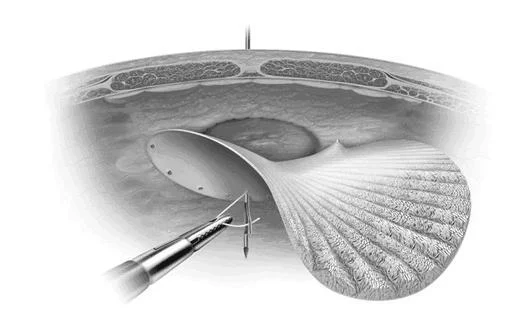
Most incisional hernias are repaired with surgical mesh. Older methods pulled the edges of the hole together with stitches. That created a lot of tension and led to frequent recurrences. With mesh, the hole is covered rather than pulled shut. Dr. Lublin places a strong mesh beneath the defect and extends it well beyond the edges of the opening. This spreads support across healthy tissue and creates a tension-free, longer-lasting repair with a lower chance of recurrence.
Laparoscopic vs. Open Repair
Mesh can be placed in one of two ways. In an open repair, the entire previous incision is reopened. In a laparoscopic repair, the hernia is fixed through a few small incisions using a camera and specialized instruments. When it is appropriate for the patient, the minimally invasive approach is preferred because it offers:
- A quicker recovery
- A shorter hospital stay
- Less pain after surgery
- A faster return to normal activity
- A lower chance of hernia recurrence
- Smaller scars and a better cosmetic result
Dr. Lublin reviews your surgical history, the size and location of the hernia, and your overall health before recommending the approach that fits you best.
Recovering After Incisional Hernia Surgery
Recovery depends on the size of the hernia and the technique used. After a minimally invasive repair, most patients walk the same day and gradually resume light activity over the following days. Heavy lifting and strenuous exercise are limited for a period so the mesh can integrate with your tissue. You will get clear instructions before you go home, and our hernia surgery care guide covers what to expect.
Incisional Hernia Questions Patients Ask
How do I know if a bulge near my scar is an incisional hernia?
A soft bulge near a previous abdominal incision is often a hernia, especially if it gets bigger when you cough, strain or stand and smaller when you lie down. A physical exam, sometimes with imaging such as a CT scan, confirms the diagnosis and shows the size of the defect.
Will an incisional hernia go away on its own?
No. Once the abdominal wall has a defect, it cannot close by itself. Most incisional hernias slowly get larger over time, and the risk of tissue becoming trapped stays as long as the hole remains open. Surgical repair is the only lasting solution.
Why is mesh used for incisional hernia repair?
Stitching the edges of the hole together puts the tissue under tension, which led to high recurrence rates in the past. Mesh covers the defect and overlaps healthy tissue around it, creating a tension-free repair that is stronger and less likely to fail.
Can a large incisional hernia be repaired laparoscopically?
Many incisional hernias, including some larger ones, can be repaired with laparoscopic or robotic techniques. The best approach depends on the size and location of the hernia, previous surgeries and your overall health. Dr. Lublin will review these factors with you at your consultation.
When does an incisional hernia need emergency care?
Get immediate medical attention if the bulge becomes firm, very painful or discolored, or if it cannot be pushed back in, especially with nausea, vomiting or trouble passing gas or stool. These can be signs of incarceration or strangulation, which need urgent surgery.
How long is recovery after incisional hernia surgery?
After a minimally invasive repair, many patients go back to light daily activity within a week or two. Heavy lifting and strenuous exercise are usually limited for several weeks. Larger or open repairs may take longer. You will get a recovery plan tailored to your procedure.
Can I lower my risk of the hernia coming back?
Following your activity restrictions, keeping a healthy weight, not smoking and managing chronic coughing or straining all help protect the repair. Using mesh placed well beyond the edges of the defect also lowers the chance of recurrence.
Get Your Incisional Hernia Evaluated
A hernia near an old scar will not improve on its own, and an early repair is usually simpler. Dr. Lublin sees patients at both of our offices, in Santa Monica and in Encino. He will examine the hernia, explain your options and recommend the repair that fits your needs. Call or request an appointment online.